Monday, February 28, 2011

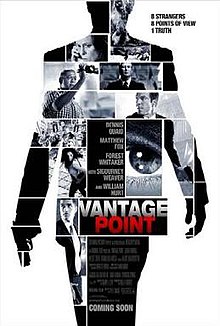
Movies that f*ck with time!!!!


These films are similar in that they all play with time in a certain way. Some show different viewpoints of the same event, while some jump around in time, not showing the events in the usual chronological order.
The films differ, however, in the reason or effect of the time manipulation. Memento uses it to lead up to the twist at the end of the film, which actually happens at the beginning of the sequence of events. Jackie Brown uses it to show different perspectives of the money tradeoff, which builds suspense for the final events.

Thursday, February 17, 2011

Run Lola Run Questions

1. When Lola gets the phone call and we see it from her perspective. The dramatic irony of seing the truth of the affair helps us to identify with Lola's anger. The scenes where she's talking to Manni in bed, break in the action, slow, no sound, red.
2. I would go back to any time when I screwed up and change things so that I didn't screw up.
3. The film supports the claim that love can do anything. The overall theme is that love makes people do crazy things, like rob a bank and run across the city. The bank guard is either lusting after her or he's the kind old man.
4. The clocks emphasize the time restraint placed on Lola. Credit sequence, asks lady for the time, dad's office, Manni looks at the clock before going in, when she gets the call in her apartment.
Glass: 1st story, glass unbroken, 2nd story broken, 3rd story unbroken. Foreshadows her emotions. Glass at the supermarket. When she screams and the glass breaks. Shows her desperation to save the one she loves.
5. Business district, clean and busy, chaos, Lola is looked down upon by older generation. Probably could have happened in a different city, but Lola would have to know the area well.
6. Shows that she's rebellious, doesn't want to fit in. She's the only one wearing bright colors so she stands out more. Rebelling against her parent's generation.
7. In the actions scenes there are tracking shots to show speed. In the hold-up, they use cross-cutting

Wednesday, February 9, 2011

Amelie

I really enjoyed this film. It was interesting and different in a way that I haven't seen any American films be different. I loved how they used exaggerations to convey the character's feelings, and I liked how they used the narrator, because he told the story without being too obtrusive. I liked how they used humor, while still maintaining a serious theme throughout the film. Overall I think I would give this film a 4/5, it was a fun film to watch. It also adds further evidence to my theory that all that French people do is smoke and have sex.

Monday, February 7, 2011

This is mah shit

Activity 12:

If I were to direct a short film I would definitely use jump cuts as used in French New Wave films such as Jean-Luc Godard's Breathless. First of all, French films are sweet. French people aren't all weird about sex and showing skin in their films like American's are. Any film I make would use some of the techniques of French films simply for the reason that I like French films. But for stylistic purposes I think it's a good idea. It's straying away from the use of clean editing that is used in many Hollywood films today, and gives a more gritty, real feel to the film. I would definitely use jump cuts in conversations, if only for the purpose of keeping the audience from falling asleep while the conversation is taking place. The jump will hopefully jar them back to the film they are watching. I would also use jump cuts in action scenes to speed up the scenes and to add suspense.


Activity 13:

Because jump cuts are so commonly used today, I think people have been jaded to them, and they are no longer as effective as they were during the French New Wave movement. The use of the jump cuts in French cinema was to jar the audience from the film, reminding them that it was a film and that the events weren't actually happening. The users of this technique were making a statement against consumerism. Ironically, jump cuts are commonly used in commercials today. While French director's used jump cuts to jar the audience, modern commercials use it to suck the viewer in, to show them their product in quick flashes that manipulates the viewer.


Activity 14:

Memento (2000)

Christopher Nolan
United States

The film follows Leonard Shelby who suffers from short term memory loss. The film chronicles Leonard searching for the man who killed his wife, while the events are shown backwards, revealing information piece by piece. Leonard writes notes and takes pictures to remind himself of things. I really enjoyed this film, and liked the use of the hand-held camera. It worked because of the nature of the plot, and also probably because of the unstableness of the protagonist. The jerky camera definitely added to the realism of the film, and I think Nolan did a good job of not overusing it. As a whole I thought the movie was great. It had an interesting plot line with plenty of twists, and the showing-the-events backwards component was an excellent addition. It makes the viewer think about the events, without them being spoon-fed to them. No other film I've seen was quite like this one, and I can easily say that this was one of Nolan's best films.

Friday, February 4, 2011

Film Festival

Long Films:
Bad Behavior
The Ceremony
The Snow Caveman
The Dead
Poligamy

Short Films:
Hangnail
Tapeworm
The Dive
No Robots
Red Snow